
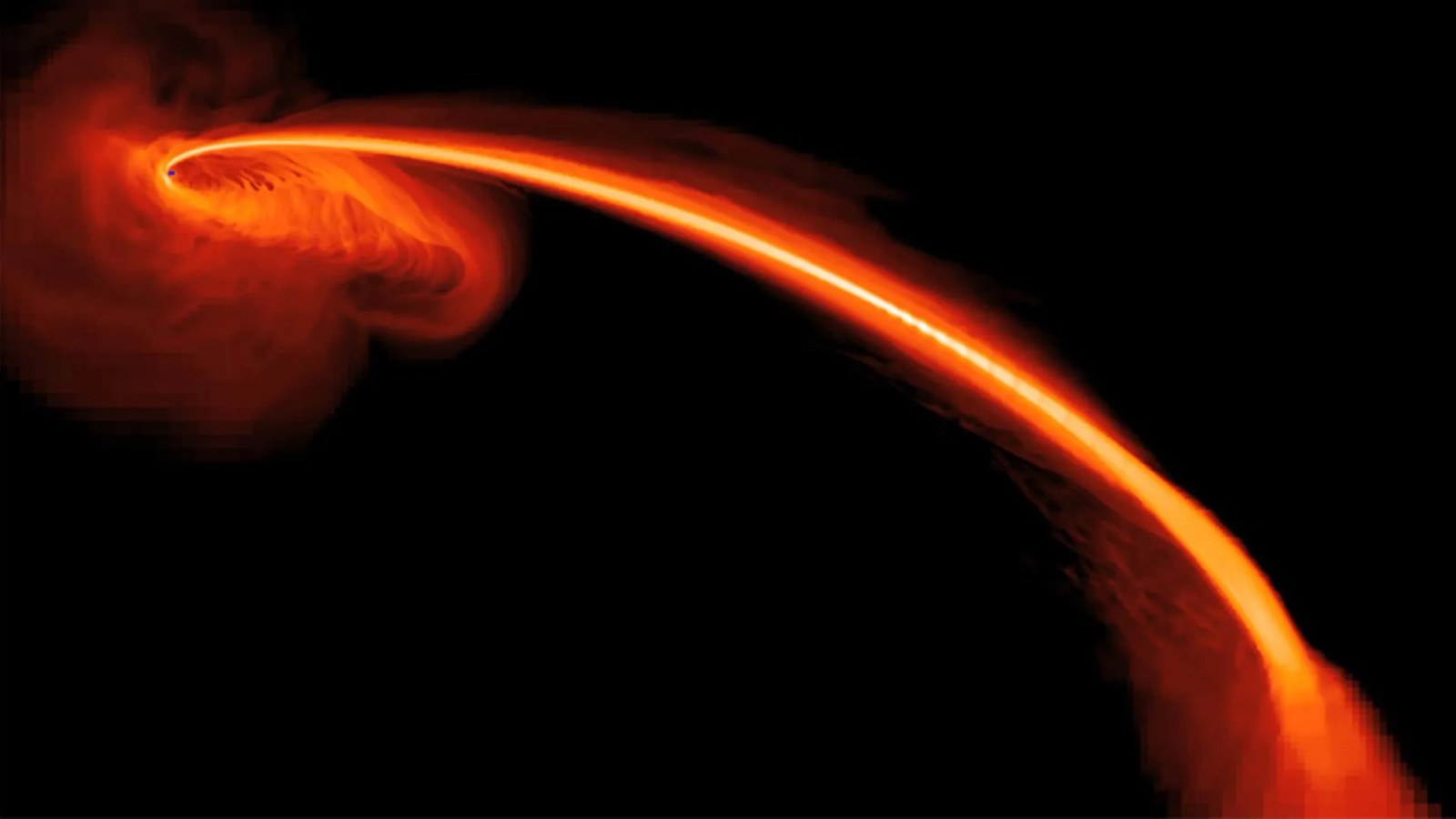
Some stars that survive a close pass by a supermassive black hole return for more encounters, producing repeating partial tidal disruption events, or rpTDEs, according to ScienceDaily. In a new study published in The Astrophysical Journal, researchers at Syracuse University say they may have found an explanation for why some of these repeating flares grow dimmer over time.
When a star passes close enough to a black hole, the black hole can strip away some of the star’s mass without destroying it completely. The surviving core stays in orbit and comes back months or years later for another pass, giving astronomers multiple chances to watch the same star interact with the same black hole.
The Syracuse team, led by doctoral student Ananya Bandopadhyay with postdoctoral researcher Benjamin Amend and associate professor Eric Coughlin, found that a star’s spin before its first encounter could be important. Their simulations suggest that if the star is already rotating quickly, it will not be spun up as much by later close passes, which keeps the fallback time for stripped material from changing much.
That difference matters because less stripped material can then translate into a lower peak fallback rate and a fainter flare on each return. The researchers say this helps match observations of several repeating systems, including four of the roughly 10 known rpTDEs that have gotten progressively dimmer.
The study also points to the Hills mechanism as a possible explanation for how a star might end up both tightly bound to a supermassive black hole and spinning rapidly. In that scenario, a binary star system is torn apart by the black hole, leaving one star behind in a short orbit.