Researchers at the University of Copenhagen have recreated a state of matter believed to have filled the universe just after the Big Bang, using collisions between atomic nuclei much smaller than scientists once thought could do the job, according to ScienceDaily.
The work was carried out at CERN in Switzerland by scientists from the Niels Bohr Institute and the international ALICE collaboration. By accelerating nuclei to near light speed and smashing them together, the team created tiny droplets of quark-gluon plasma, the hot and dense matter thought to have existed during the first millionth of a second after the Big Bang.
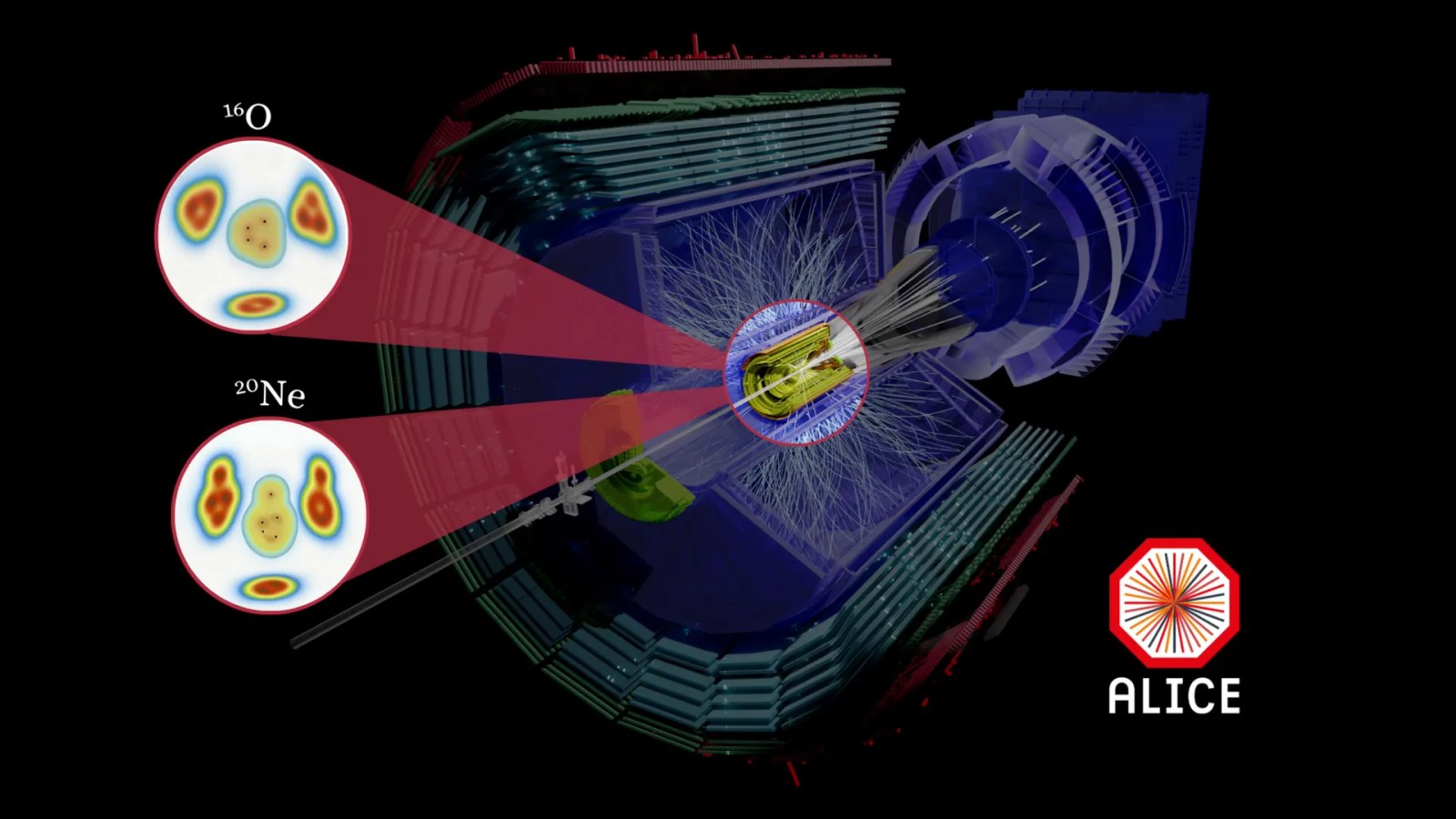
For years, physicists assumed that only very heavy nuclei, such as lead, could generate this plasma. The new experiments showed that oxygen-16 and neon-20 nuclei were also able to produce the primordial material. Lead researcher You Zhou said the team had pushed the limit for how small the nuclei can be while still recreating what he called a “Little Big Bang.”
The researchers cannot observe the plasma directly, so they study the particles that appear after the collision. Their results suggest those movement patterns preserve information about the shape of the original nuclei, with oxygen collisions producing a more rounded pattern and neon collisions creating a bowling-pin-like pattern.
The team says the method could open a new way to study the structure of atomic nuclei and better understand the strong force. They plan to continue with experiments using even lighter nuclei, including helium-4.